
How Does a Professional Audio System Work?
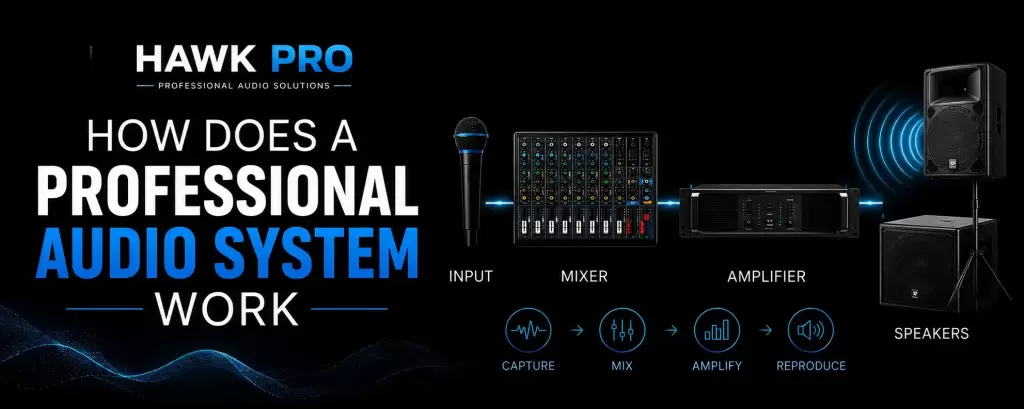
Receiving clear and consistent sound is not random; it requires sound system planning, audio routing, and a properly set up audio signal chain working together.
If you plan to create an audio system for a conference room, auditorium, house of worship, recording studio, or live event hall, you must understand how a professional audio system works to properly set up your installation. An effective audio installation relies on an efficient audio signal management system that enables audio to travel seamlessly from the point of origin to the audience.
Modern AV systems integrate several technologies and devices to capture, process, transmit, and reproduce sound. The knowledge of the entire audio signal chain enables users to construct better sound systems, diagnose problems more quickly, and engineer a better listening experience.
What Is a Professional Audio System?
A professional audio system is a set of interconnected equipment that can record, process, control, and output sound in commercial and professional settings, often forming a complete sound reinforcement system.
The important difference between a consumer audio system and a professional audio system is that they are made to be reliable, scalable, and perform at high quality. From concert halls to schools, churches, or corporate functions, all sound system setups depend on planning and audio routing.
A typical system may consist of microphones, mixers, signal processors, amplifiers, speakers, monitoring equipment, and connections that are linked together as essential sound system components within an orderly audio signal chain.
Understanding the Audio Signal Chain
The audio signal chain is the full route that an audio signal takes from its source to its output device.
Any step along the audio signal path affects the overall quality of the audio. A carefully designed system provides a clear signal path, minimal noise, and improved audio quality.
Where the Signal Begins
All sound signal chains begin with a sound source.
Common audio sources include:
– Human speech
– Musical instruments
– Playback devices
– Computers
– Multimedia systems
The performance of the whole sound system setup depends directly upon the quality of the source.
Capturing the Audio Signal
The next step in the audio signal chain is to record audio using mics.
Microphones come in a variety of different types, depending on the application.
– Wireless Microphones for mobility and flexibility
– Condenser Microphones for detailed sound capture
– Dynamic Microphones for durability and live applications
Choosing the right microphone is a critical part of any professional sound setup because it determines how accurately the original sound is captured.
Signal Transfer Through Audio Routing
Once the sound is captured, it must travel through the system using effective audio routing.
Audio routing is the way audio signals are directed and the path they travel between devices. Signal routing in audio is the process of ensuring that audio signals are sent to the right places without any interference or degradation.
To achieve efficient audio routing, systems often use:
– Audio Cables
– XLR Connectors
– Stage Boxes
– Networked audio solutions
A properly designed audio routing system makes these installations more reliable and easier to troubleshoot.
Audio Mixing and Processing
After routing, signals enter the mixing and processing stage.
At this point, audio engineers control:
– Volume levels
– Equalization
– Dynamics
– Effects processing
– Channel balancing
This stage plays an important role in the overall audio system design and helps optimize the performance of the complete live audio system.
Effective processing ensures the audio signal chain remains balanced and consistent throughout the venue.
Signal Conversion and Balancing
Signals have to be converted and balanced as they pass through the system.
To convert unbalanced signals to balanced signals, noise is reduced, and signal integrity is enhanced by the use of devices like DI Boxes.
A crucial factor to take into account in audio routing is the right signal balancing, which is essential for good audio quality on long cable runs.
This process is particularly critical in a large-scale audio equipment setup where various pieces of equipment are connected.
Monitoring the Audio Signal
Monitoring allows engineers and performers to hear the audio before it reaches the audience.
Common monitoring equipment includes:
– Studio Monitors
– Headphone Amplifiers
– In-ear monitoring systems
Monitoring is used to detect problems early and make sure that the sound chain is working.
An effective monitoring solution is a key component of any professional sound setup.
Power Amplification Stage
Before audio reaches the audience, the signal must be amplified.
Amplifiers boost the strength of a signal and prepare it for an amplifier output.
Today, many systems incorporate amplification directly into powered speakers, thereby eliminating much of the equipment complexity to make up a sound system.
This is an important stage to ensure an even sound level in a live sound setup.
Delivering Sound to the Audience
The final stage of the audio signal chain involves sound reproduction.
This is achieved through:
– Speakers
– Line arrays
– Subwoofers
– Distributed audio systems
The aim is to deliver consistent and clear audio across the venue to all listeners.
If the audio distribution system is set up correctly, the output will be representative of the original signal generated.
Complete Sound System Setup Diagram
A typical sound system setup follows this signal path:
Audio Source → Microphone → Audio Routing → Mixer → Signal Processor → Amplifier → Speakers → Audience
This is a simplified model that is meant to show how all the devices in the overall audio path work and demonstrate the complete audio signal flow.
Understanding this workflow helps engineers build a more efficient professional audio system and improve overall system performance.
Common Audio Routing Challenges
Even well-designed systems can experience problems if audio routing is not planned correctly.
Common challenges include:
– Signal noise
– Ground loops
– Feedback issues
– Incorrect channel assignment
– Signal loss over long cable runs
– Routing conflicts
These problems can be avoided, and a smooth operation can be provided by proper signal routing in audio.
Documenting and testing regularly can greatly enhance the reliability of a live audio system.
Best Practices for Professional Sound System Setup
A successful professional sound setup requires more than just connecting equipment.
Recommended best practices include:
– Design the audio signal chain before installation
– Label all routing paths clearly
– Use high-quality connectivity solutions
– Verify signal flow at every stage
– Test all outputs before events
– Plan future expansion requirements
– Maintain organized cable management
These practices will help establish a more stable sound system setup and to enhance overall system performance.
How Different Industries Use Professional Audio Systems
Educational Institutions
Professional audio systems are used to deliver lectures in schools, colleges, and universities, and for events and campus-wide communication.
Corporate Environments
Meeting rooms and conference centers use structured audio routing and distributed audio systems for presentations and hybrid meetings.
Houses of Worship
Modern worship facilities require advanced live sound setup solutions for sermons, music, and community gatherings.
Live Entertainment Venues
A well-designed audio signal chain is essential for concert venues to provide high-quality sound experiences.
Government Facilities
Scalable audio system design solutions are often necessary for public announcements, conferences, and official events.
Choosing the Right Professional Audio Equipment with HawkPro
Considerations for building a successful, professional audio setup include equipment selection.
When evaluating equipment, consider the following:
– Venue size
– Audience capacity
– Acoustic conditions
– Future scalability
– Connectivity requirements
– Monitoring needs
HawkPro can supply a variety of professional audio equipment, including microphones, speakers, stage connectivity devices, and audio accessories, for commercial installations and live sound applications.
With the right gear, accurate audio routing, and a well-designed audio signal chain, any organization can create reliable audio systems with consistent performance.
Frequently Asked Questions
1. What is an audio signal chain?
An audio signal chain is essentially the entire route that an audio signal takes from the very first device generating the sound, right up to the last device that outputs the sound.
2. What is audio routing in a professional audio system?
Audio routing means the method of sending audio signals from one device to another in a professional audio setup to maintain a smooth and correct flow of signals within the system.
3. Why does proper sound system setup matter?
Effective sound operation, quality sound, and uniform sound coverage throughout the venue require the proper setup of the sound system.
4. What is the standard professional sound system equipped with?
A standard, professional sound system is equipped with microphones and a mixing console, plus audio processors, power amplifiers, and loudspeakers. It also has a monitoring system, along with different kinds of cables and connectors, which together make up the basic elements of the setup.
5. How will audio routing impact sound quality?
Proper audio routing is one of the elements leading to better sound quality since it not only reduces signal loss but also decreases interference and ensures the signal’s purity during its transfer within the system.
6. How can you tell the difference between a sound system and a passive sound system?
The major difference is that with an active sound system, the amplifiers are already built into the system, whereas with passive sound systems, the amplifiers are separate from the system and require to be powered by another amplifier.
Add Comment