
Audio Cable Buying Guide : Find the Perfect Cable for Your Sound System
Choosing the correct cable makes for better sound. From a home studio to a live event rig, recording setup to commercial installation, cable quality directly impacts signal transmission and system reliability. By helping users grasp the various factors that can affect sound quality, durability, and compatibility, an Audio cable buying guide can assist them in making informed decisions.
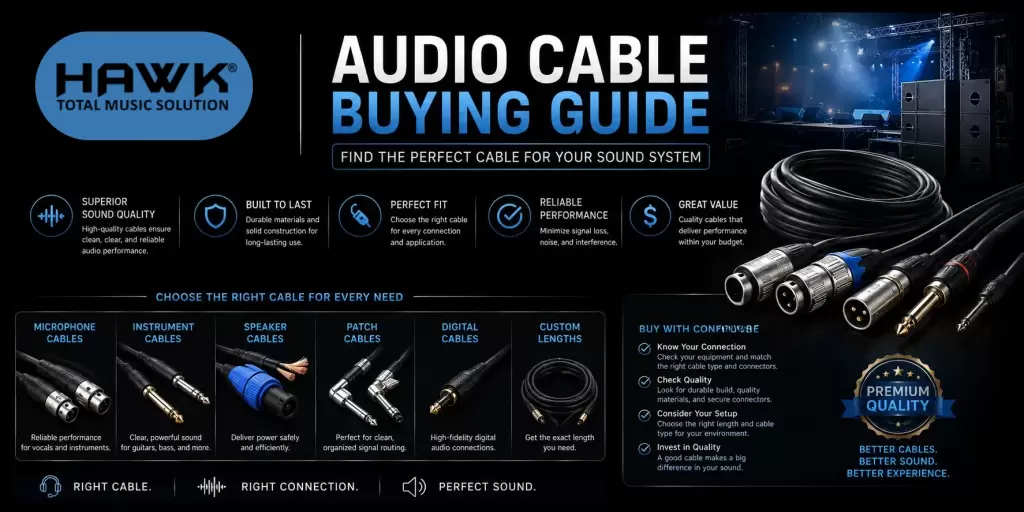
Meanwhile, a Speaker Cable Buying Guide, Network Cable Buying Guide and Digital Cable Buying Guide offer valuable information about selecting the appropriate cable for the appropriate applications. This guide describes cable types, important considerations when purchasing cables and professional recommendations to help you make a decision.
Why Choosing the Right Audio Cable Matters
The right cable will help maintain a clean signal, reduce interference, and help extend the overall longevity of the system. An Audio cable buying guide can assist you in avoiding signal loss, noise and connection issues.
A quality cable contributes to:
– Better audio performance
– Reduced interference
– Improved durability
– Reliable connectivity
Whether you are following a speaker cable buying guide for loudspeaker connections or a Digital cable buying guide for digital transmission, selecting the correct cable helps maintain consistent performance.
Many professionals involved in Professional Audio System Work consider cable selection as important as choosing mixers, speakers, and processors.
Understanding Different Types of Audio Cables
The first step in choosing the right cable solution is to understand the different audio cable types.
Common types of audio cables include:
– XLR cables
– TRS cables
– TS cables
– RCA cables
– Ethernet cables
– USB audio connections
– Speaker cables
– AES/EBU digital cables
An Audio cable buying guide often recommends considering the kind of audio signal that is being used, not just the look of the cable.
For example:
– A digital audio cable is designed for digital signal transmission.
– An audio USB cable is commonly used for connecting audio interfaces and digital devices.
– A USB audio cable is essential in modern recording and streaming setups.
A Network cable buying guide focuses on network-based audio systems, while a speaker cable buying guide helps users choose cables that can safely handle speaker-level signals.
Balanced vs Unbalanced Audio Cable Details
One of the most important concepts in audio connectivity is balanced audio.
A balanced connection uses three conductors to reduce noise and interference. This makes it ideal for long cable runs in professional environments.
Benefits of balanced audio include:
– Lower noise levels
– Better signal integrity
– Improved reliability
When comparing balanced vs unbalanced audio cable options, balanced cables are generally preferred for professional installations.
Unbalanced cables are suitable for shorter ranges, but are more susceptible to electromagnetic interference.
In most of the studios, live venues and broadcast facilities, most of the professional audio cables are balanced cables.
How to Identify Best Quality Cables (Digital, Audio, Network Speaker)
Not all cables are built to the same standard. An Audio cable buying guide should focus on quality indicators rather than price alone.
When evaluating cable quality, consider:
– Shielding
– Connector quality
– Conductor material
– Flexibility
– Durability
– Compatibility
A Digital cable buying guide emphasises signal stability, while a speaker cable buying guide focuses on current handling and conductor size.
Likewise, a Network cable buying guide prioritises bandwidth, network performance, and installation requirements.
Check Cable Length Requirements
Cable length affects both performance and installation convenience.
An Audio cable buying guide recommends using only the length required for the application.
Excessively long cables may:
– Increase clutter
– Create signal management challenges
– Raise installation costs
When following a speaker cable buying guide, longer runs may require thicker conductors to maintain performance.
Similarly, a Network cable buying guide should account for the maximum supported cable distances.
Choose the Correct Connector Type
Connector selection is critical for compatibility.
Common connectors include:
– XLR
– TRS
– TS
– RCA
– USB
– EtherCON
A Digital cable buying guide should always verify connector compatibility with the connected equipment.
Likewise, an Audio cable buying guide recommends checking input and output requirements before purchasing.
Evaluate Cable Shielding
Protection is provided for cables from electromagnetic and radio-frequency interference.
Good shielding is especially important in:
– Live events
– Broadcast facilities
– Recording studios
– Commercial installations
A Digital cable buying guide often prioritises shielding because digital signals can be affected by transmission errors.
A Network cable buying guide also emphasises shielding in electrically noisy environments.
Check Flexibility and Durability
Cables in professional settings need to be able to be used regularly.
Important considerations include:
– Outer jacket quality
– Bend resistance
– Strain relief
– Connector strength
A speaker cable buying guide should prioritise durability for touring and live production applications.
A readymade cable may be suitable for simple installations, while custom cable solutions may better serve demanding environments.
Consider Conductor Material
The quality of the conductor is important regarding performance and longevity.
Copper has become the universal material for its durability and reliability because it provides:
– Excellent conductivity
– Durability
– Cost efficiency
An Audio cable buying guide often recommends oxygen-free copper for professional applications.
The Roll Cable option enables the installer to roll a cable of their desired length that is needed for the project.
Ensure Compatibility with Equipment
Every cable must match the equipment being connected.
For example:
– Audio interfaces require an audio USB cable
– Digital processors require a suitable digital audio cable
– Loudspeakers require appropriate speaker cabling
A Network cable buying guide should verify network standards and infrastructure requirements before installation.
A Snake Cable is designed to make a large setup easier with one cable assembly than multiple cables.
Look for Professional-Grade Build Quality
Professional cables have higher reliability and a long service life.
Signs of quality include:
– Metal connectors
– Strong strain relief
– Quality shielding
– Durable jackets
A speaker cable buying guide will provide you with information on build quality, as well as conductor size and performance.
Good quality, professional audio cables are more likely to be of value in the long run than cheap ones.
Verify Signal Type
Understanding signal type is critical when selecting cables.
Analog
Analogue signals are electrical signals with continuous waveforms that are typically found in microphones, instruments and mixers.
A proper understanding of audio signal fundamentals helps users select suitable analogue cables.
Digital
Digital signals transmit data using binary information.
A Digital cable buying guide assists users in selecting the right digital cable for any digital processor, audio interface or network system.
Ideally, the best digital audio cable should offer stable data transmission, secure connections, and robust shielding.
Speaker-Level
Speaker-level refers to the power level sent to the speaker from the amplifier.
The main aspects of a speaker cable buying guide are conductor gauge, cable construction, and current handling.
To keep a reliable Sound Reinforcement System, the proper selection of cables is important.
Best Professional Cable Brands: What to Look For
When it comes to opting for professional audio cable brands, choosing products with proven reliability and quality is essential.
When checking out the best quality audio cables, take into account:
– Build quality
– Connector reliability
– Shielding performance
– Warranty support
– Industry reputation
Among emerging solutions, Hawk Pro has gained attention for offering durable professional audio cables, dependable network solutions, and installation-friendly products designed for professional applications.
When buying a Network cable buying guide, a digital cable buying guide, an audio cable buying guide and a speaker cable buying guide, a reputable brand can help you get better performance in the long run.
Conclusion
The right cable is crucial for getting reliable audio performance and stability in your system. A good Audio cable buying guide will assist users to comprehend the different kinds of cables used, connectors, shielding and compatibility requirements.
Likewise, a speaker cable buying guide, a network cable buying guide, and a digital cable buying guide offer valuable guidance in the selection of cables for particular applications. The emphasis on quality construction, signal handling, and dependable brands like Hawk Pro enables users to create trustworthy audio systems with predictable performances.
Add Comment